
Last updated October 31, 2026
 Home additions & ADU
 Kitchen remodeling
 Bathroom remodeling
 Roofing
 Windows & doors
 Driveway & pavers
 Fence
Free written scope consultation - allowances, timeline, and change-order rules on paper before a single trade is scheduled
Construction Warning Signs: A Santa Cruz Homeowner’s Reference Guide
Efflorescence on a concrete retaining wall gets dismissed as cosmetic almost every time. It’s not. It’s a mineral trace left behind as water moves through the wall, and on Santa Cruz hillside lots with winter saturation, that chalky white residue is roughly a 12-month warning before the wall starts to displace. This guide and our General Contractor Troubleshooting: Common Problems and How to Fix Them teach you to read the slow signals your house sends before they become structural problems. We’ll cover exterior failures, roof system warnings, hardscape red flags, and the interior moisture patterns that trace back to construction defects most inspectors never flag.
Styles & brands we work with
Quick Answer
Construction warning signs in Santa Cruz homes follow predictable patterns tied to coastal moisture, winter rain, and hillside drainage. The most reliable early indicators are paint failure at siding joints, granule loss on asphalt shingles, soil heave at paver edges, and baseboard staining on walls that share exterior grade contact. Catching these in the first 12 – 24 months saves $15,000 – $40,000 compared to repairing what they become if ignored.
Table of Contents
- Exterior Warning Signs: Paint, Siding, and Hardware
- Roof System Warning Signs Beyond Missing Shingles
- Hardscape and Drainage Red Flags
- Interior Moisture Signals That Trace Back to Exterior Failures
- Triage: GC Problem vs. Trade-Specific Emergency
- Santa Cruz-Specific Factors: Climate, Soil, and Code
- Common Mistakes to Avoid
- When to Call a Professional
- Frequently Asked Questions
- The Bottom Line
Exterior Warning Signs: Paint, Siding, and Hardware
In Santa Cruz, exterior failures almost never start as obvious rot. They start as micro-separations that let moisture sit against sheathing for months before visible damage appears. The climate here changes things: marine air keeps surfaces damp through summer mornings, and winter storms drive rain horizontally against west and south-facing walls. Paint on a Santa Cruz house doesn’t just age. It fails in patterns that tell you exactly what’s happening underneath.
The three exterior signals we see most often on coastal properties:
- Paint peeling at siding butt joints, not faces. When paint peels along the bottom edges of horizontal lap siding but the face stays intact, water is sitting in the joint, not running off. This points to capillary action drawing moisture behind the board. In Santa Cruz, this shows up fastest on the north and west sides where sun exposure never fully dries the joint.
- Rust staining below exterior hardware. Stainless or coated screws that show rust tracks down the siding within two years mean the fastener was either the wrong grade for coastal salt air or installed without proper isolation. The staining is cosmetic, but the fastener failure behind it is structural. On decks and railings near the water, we’ve seen this accelerate to hardware failure in under five years when standard zinc hardware was specified instead of 316 stainless.
- Siding joint separation that widens at specific elevations. When gaps between siding boards open more at one story than another, the framing behind that section is moving. The differential settlement might be mineral soil under one corner or a drainage path eroding material away. Sealing the gap without addressing the movement just traps moisture in the cavity.
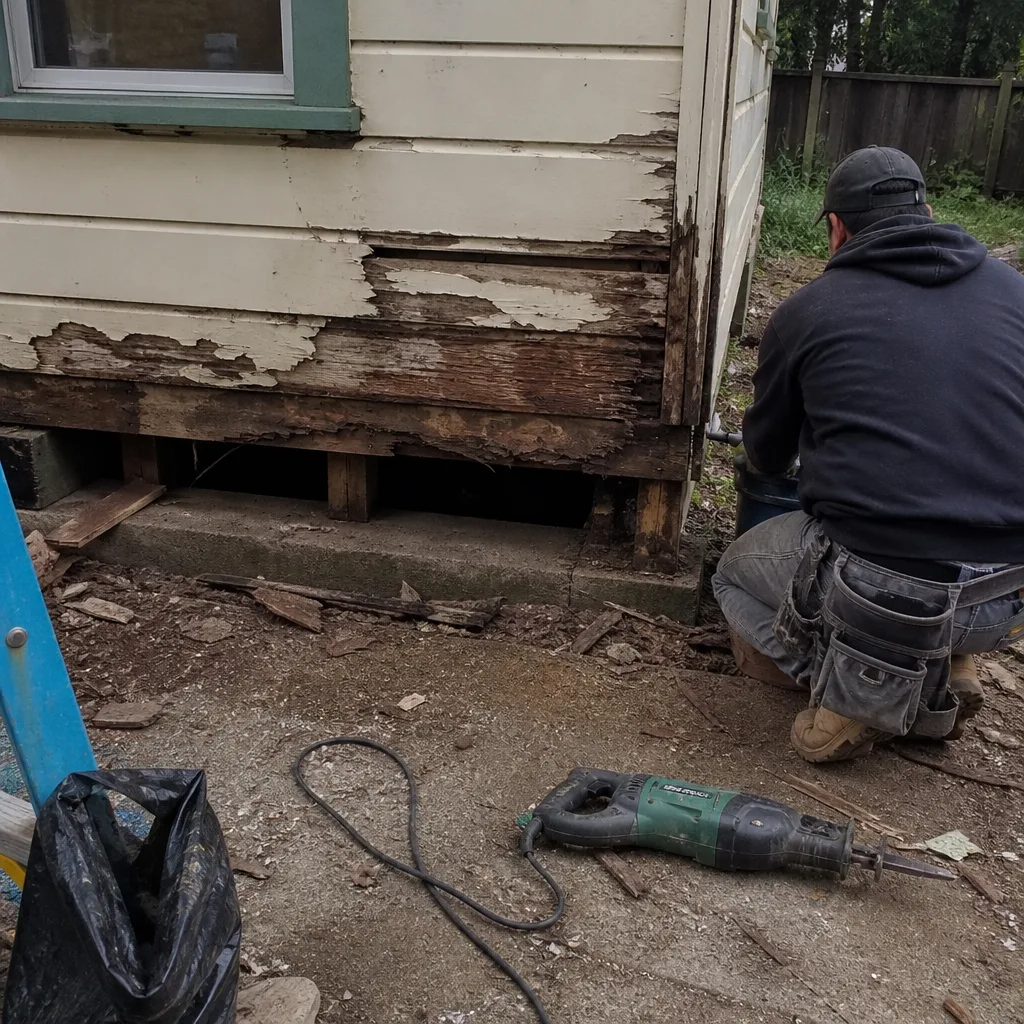
Here’s what this looks like in practice. We were called to a home off Western Drive where the homeowner wanted us to repaint a section of hardboard siding. The paint had failed at the joints in a stair-step pattern running from the deck ledger down to the mudsill. We pulled two boards and found the sheathing behind them at 32% moisture content. The deck ledger’s flashing had been installed behind the siding but in front of the housewrap, which is backwards. Every winter rain was directing water into the wall cavity. The fix wasn’t paint. It was removing 14 feet of siding, replacing the flashing, and drying the cavity before re-cladding. If that homeowner had just repainted, they’d have rotting sheathing inside three years.
For homeowners planning a remodel, these early signals matter because the repair scope changes based on when you catch them. Our home remodeling in Santa Cruz work often starts with us finding these exterior warning patterns during the initial walkthrough, and the timing of the catch directly changes the price of the fix.
Roof System Warning Signs Beyond Missing Shingles
Missing shingles are the easiest roof problem to spot and the least common early warning. Here’s what actually precedes most total replacements in Santa Cruz:
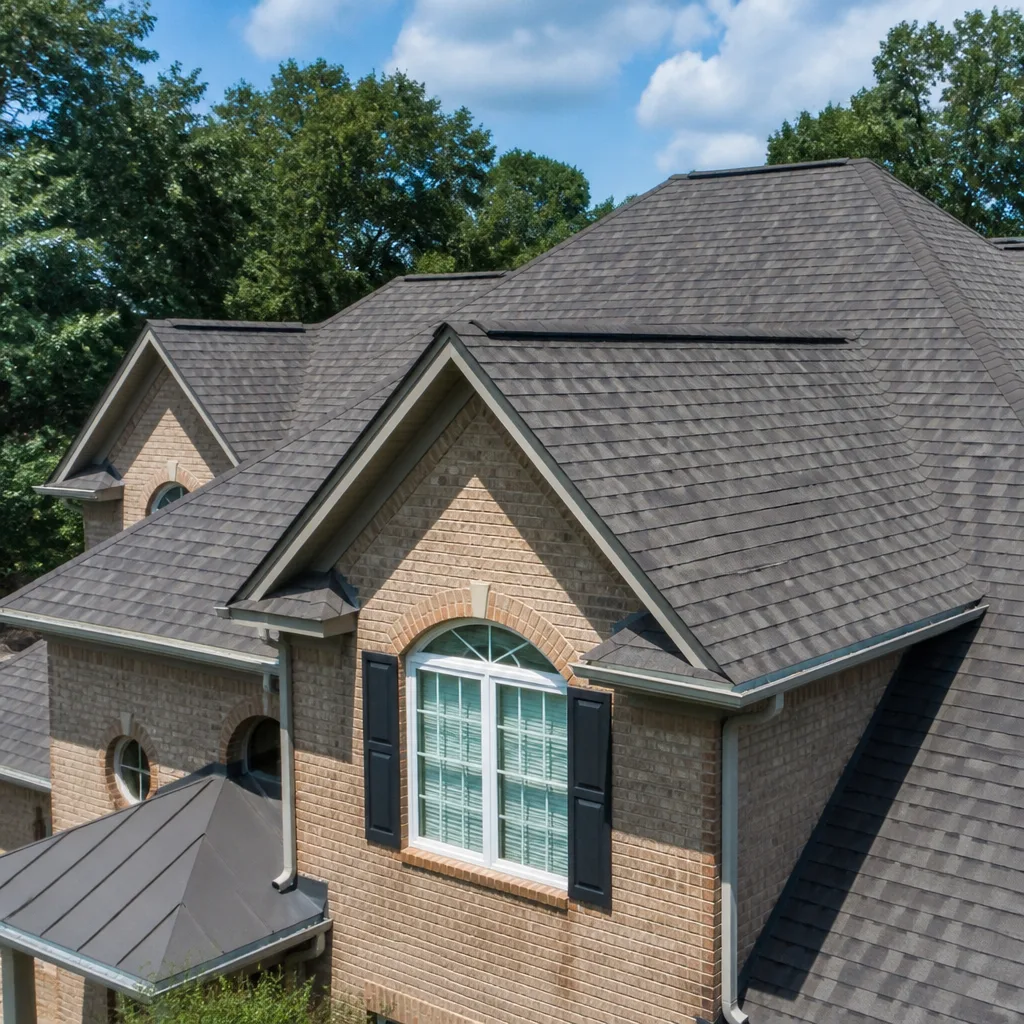
- Granule loss concentrated in specific bands. Asphalt shingles shed granules constantly, but uniform loss across the roof is just aging. Concentrated loss at specific bands points to a problem. When granules pile up in valleys or collect in gutters under specific slopes, that’s a sign those shingles are taking on water. In Santa Cruz, we see this most often where roof transitions create a channel for wind-driven rain or where a tree canopy keeps specific sections wet.
- Flashing separation at valleys and penetrations. When step flashing pulls away from a pipe boot or a valley edge by even 3 – 4 millimeters, the seal is broken. The failure is subtle and looks like a cosmetic gap. But that gap channels water directly to the underlayment. Valley flashing separation is the single most common source of slow leaks we find on Santa Cruz roofs that are 8 – 12 years old, especially on steep lots where mechanical stress from differential settling pulls on the flashing joints.
- Gutter overflow evidence that can’t be explained by debris. Water stains on the fascia below the gutter line, or erosion channels in the soil directly below downspout discharge points, mean the gutter system was sized wrong for the roof area. On larger footprints, undersized gutters overflow during heavy rain even when perfectly clean. The water never makes it to the downspout. It sheets over the edge and sits against the foundation. This one is especially common on Santa Cruz additions where the roof area was expanded without re-evaluating the drainage plan.
What to do when you catch any of these:
- Photograph the area on a dry day, then again during or immediately after rain. Compare the water flow pattern.
- Check the attic space below the warning sign with a flashlight. Staining on the underside of the sheathing tells you the leak is active and finding its way inside.
- If you can’t access the attic, watch the ceiling below for discoloration over the next 30 days after rain. Small dime-sized spots after heavy rain mean active water entry.
- If any of these confirm, call for a roof inspection before the next rain season. Flashing and gutter issues are $400 – $1,200 fixes. By the time they become visible interior leaks, the repair is a $3,000 – $8,000 task.
One more thing worth saying about Santa Cruz specifically: salt air accelerates corrosion of any metal roof components. If you have a standing seam metal roof or metal flashing and you live within a mile of the water, the fasteners and seams will degrade faster here than they would in Scotts Valley or Felton. Budget for an inspection every three years instead of every five.
Hardscape and Drainage Red Flags
The drainage failures that damage Santa Cruz homes usually start outside the house and work their way in. Pavers, concrete, and retaining walls show warning signs 12 – 24 months before the water reaches the foundation. Reading them early is cheap. Ignoring them is expensive.
| Warning Sign | What It Looks Like | What It Actually Means | Typical Santa Cruz Cause |
|---|---|---|---|
| Soil heave at paver edges | Pavers lift at the perimeter; edges look slightly domed | Water is saturating the subgrade and expanding clay or silt | Poor drainage below the paver base; downspout discharge too close to hardscape |
| Concrete joint cracking in stair-step pattern | Hairline cracks that follow the joint pattern, not random | Differential settlement; one side of the slab is moving | Hillside creep after winter saturation; erosion from a broken drain line |
| Downspout erosion channels | Visible trenching at discharge points; bare soil or washing gravel | Water is being concentrated and redirected at volume | Undersized downspouts; too few discharge points for roof area |
| Efflorescence on retaining walls | White chalky residue on wall face; appears after rain | Water is moving through the wall; minerals are being deposited as it evaporates | Inadequate drainage behind the wall; no weep holes or blocked ones |
Efflorescence deserves more attention because it’s so consistently ignored. That white residue on your retaining wall is proof that water is moving through the entire wall section. In Santa Cruz’s winter-wet hillside lots, that water movement is eroding soil behind the wall with every cycle. We’ve seen walls where the efflorescence appeared two winters before any visible displacement. The homeowners painted over it. By the time they called, the wall had moved 4 inches and the repair required full demolition and reconstruction with proper gravel backfill and drainage matting.
For hardscape issues, the fix order matters. Here’s the sequence that works:
- Identify the water source before touching any stone. The paver, wall, or slab is a symptom, not the cause.
- Fix the drainage path. Redirect downspouts, add catch basins, or regrade the soil so water moves away from the hardscape.
- Address the subgrade. If clay has saturated and expanded, it may need to dry or be replaced with compacted aggregate before re-laying pavers or repairing concrete.
- Rebuild the hardscape surface last. This order prevents the same failure from repeating.
One of the least appreciated parts of full-scope work is that these fixes interact with each other. This is why managing the whole property under one contractor matters. If we’re doing a home renovation in Santa Cruz that includes kitchen work, but the property has a retaining wall that’s slowly moving because of drainage problems, fixing the wall after the renovation means bringing heavy equipment back through a completed landscape. The sequence of work is a construction strategy question, and it’s one of the reasons we plan projects from the outside in.
Interior Moisture Signals That Trace Back to Exterior Failures
Interior moisture shows up in specific ways that tell you where the exterior failure is. The location of the staining, the shape, and the timing all help diagnose the cause before you ever open a wall.
- Window condensation between panes. When a double-pane or triple-pane window shows fog between the glass, the seal has failed. The argon or krypton insulating gas has escaped and the window’s insulating value is gone. In Santa Cruz’s mild climate this doesn’t cause immediate energy penalties, but it does mean the window needs replacement or a new IGU (insulated glass unit). If the fog appears after rain rather than during temperature swings, the cause may be the window’s flashing letting water into the frame, not just a failed seal. That’s a construction problem, not a window problem.
- Baseboard staining in stair-step or symmetric patterns. When baseboards show water staining at repeated locations along a wall, the cause is usually an exterior plumbing or drainage issue. The pattern maps to the stud bay layout. Water from a failed exterior seal enters the wall cavity at one point, runs down the sheathing, and pools at the baseplate. The stains appear wherever the baseplate intersects a stud bay that’s carrying water. Symmetric staining across multiple rooms usually means the wall shares that exterior elevation and the problem is a single point of entry high up.
- Ceiling discoloration location as a diagnostic tool. Brown or yellow staining at the perimeter of the ceiling near an exterior wall usually traces to a roof edge or fascia issue. Staining in the center of a room points to a leak at a roof penetration directly above like a pipe collar, skylight, or attic vent. Staining that forms an arc or curve across the ceiling maps to water pooling on the inside surface of the roof deck and running along a rafter before dripping. Each of these patterns tells a different story about where to start looking.
One diagnostic trick we use: If the stain is brown and stays brown year-round, the leak is either slow and persistent (like a pinhole in flashing) or happened once and is no longer active. If the stain changes color or spreads after rain, the leak is active. If the stain has a white or chalky margin, the water has been evaporating and re-wetting repeatedly, which means the problem is chronic and tied to seasonal moisture patterns. In Santa Cruz, chronic seasonal staining almost always maps to the winter rain season, so watch those margin lines from November through March.
Window failures can also be a sign of broader envelope problems. We specify brands like Therma-Tru for entry doors and PGT for windows on coastal properties because the frames, flashing accessories, and hardware are engineered as a system. When a window frame fails at the installation flange rather than at the glass seal, the problem is usually the rough opening preparation, not the window. That’s an installation failure, and it’s why we talk about manufacturer specifications rather than just product names.
Triage: GC Problem vs. Trade-Specific Emergency
Not every warning sign requires a general contractor. Here’s how to think through who to call first.
| Warning Sign | Who to Call First | Why |
|---|---|---|
| Roof leak at a single penetration (pipe boot, skylight, vent) | Roofer | Isolated to one trade; the fix is a single flashing repair or boot replacement |
| Baseboard staining that appears in multiple rooms along the same exterior wall | General contractor | The water entry point is likely an exterior envelope failure that may involve siding, flashing, and sheathing repair, not a single trade |
| Efflorescence on a retaining wall with no visible displacement | Drainage specialist or general contractor | The fix requires understanding the water source, not just applying a sealant |
| Concrete joint cracking that follows a stair-step pattern | Geotechnical or general contractor | Differential settlement is a structural issue that may require soil evaluation before any concrete repair |
| Window condensation between panes only | Window specialist | Isolated IGU failure; replacement or reglazing is straightforward |
| Window condensation between panes plus staining around the window frame | General contractor | The flashing or rough opening may be compromised; fixing just the IGU will not stop water entry |
The pattern here is that trade-specific problems have one cause and one fix. General contractor problems have multiple causes or a cause that lives in the building envelope where several systems meet. If the warning sign is isolated and you can identify the exact source, call the trade. If you’re not sure where the water is coming from, or if two or more warning signs appear together, a general contractor should evaluate the whole assembly.
This matters because of how the trades are structured. A roofer will fix the roof. A painter will paint over the stain. A window company will replace the window. But if the root cause is a wall cavity that’s been wet for eight months because of a failed kickout flashing above the window header, none of those fixes will last. The water will find another path. That’s the difference between treating a symptom and fixing the system.
Santa Cruz-Specific Factors: Climate, Soil, and Code
Santa Cruz has a construction environment that’s different from most of California’s Bay Area. The patterns that matter for warning signs:
- Coastal marine layer means surfaces stay damp longer. Even outside rain season, morning fog condenses on exterior surfaces and keeps siding, paint, and wood decking wet for hours longer than inland locations. This accelerates paint failure at joints, increases mold growth on north-facing walls, and slows the drying of any envelope that’s already taking on water.
- Hillside soils are mineral-rich and erosion-prone. Much of Santa Cruz sits on decomposed granite, marine sediments, or clay lenses. These soils behave differently under saturation. Clay expands when wet and loses shear strength when fully saturated, which is why hillside retaining walls and foundations show new movement after heavy rain years. The Loma Prieta earthquake history means many homes have existing structural repairs or retrofits from the 1990s, and those connections don’t always age well when moisture gets involved.
- Building code requirements for coastal exposure are stricter. Santa Cruz’s coastal zone has additional requirements for corrosion-resistant fasteners, impact-resistant glazing in some locations, and enhanced drainage detailing. Homes built before the current codes sometimes lack these details, which is why we see specific failure patterns on older coastal properties that don’t appear inland.
What this means for homeowners: If your home is more than 20 years old and you haven’t had an envelope evaluation, the warning signs in this guide are likely already present in some form. The question is whether you catch them early or wait until they become structural. We offer free estimates for Santa Cruz homeowners, and we walk the property with you to identify these patterns before recommending scope; see also our General Contractor Maintenance Checklist for Santa Cruz Homeowners. It’s the fastest way to know what you’re working with.
Common Mistakes to Avoid
- Painting over efflorescence or staining without addressing the water source. The paint will fail within six months and the wall will continue to deteriorate behind it. White chalky residue is a diagnostic signal, not a surface problem.
- Sealing cracks in concrete or stucco without checking for differential movement. A crack that’s still moving will re-crack adjacent to the sealant. Worse, sealing traps water inside the crack and accelerates rebar corrosion if the concrete is reinforced.
- Replacing windows before checking the flashing at the rough opening. This is the single most common bad repair we see in coastal Santa Cruz. The new window gets installed with the old flashing left in place, and the leak returns within two years.
- Repairing only the interior wall after a leak while leaving the exterior entry point open. Mold remediation on the interior without fixing the envelope is wasted money. The moisture source must be eliminated before any interior repair begins, or the problem reoccurs.
- Assuming a roof is fine because there are no missing shingles. Flashing separation, granule loss, and gutter overflow cause more slow leaks than missing shingles ever will. The most expensive roof repairs we see in Santa Cruz are from roofs that looked intact from the ground.
- Ignoring downspout discharge location. Water discharging onto a sloped lot near the foundation finds its way under the footing through the path of least resistance. Moving the discharge point 4 feet away from the foundation costs $40 in parts and prevents $10,000+ foundation repairs.
When to Call a Professional
Call a general contractor when you see two or more of these warning signs together, when a water stain is spreading or changing color after rain, when a retaining wall has visible displacement or new efflorescence appearing over multiple seasons, or when you can’t identify the water source. Also call if you’re planning a renovation and any of these conditions exist. Scope decisions made before these issues are diagnosed will come back as change orders later. Spruce Contractors offers free estimates in Santa Cruz – call (877) 265-5771 and we’ll walk the property with you, identify what’s happening, and tell you what needs to be addressed before renovation scope is finalized.
Frequently Asked Questions
The most common warning signs in Santa Cruz are efflorescence on retaining walls, paint failure at siding joints, granule loss on roof shingles near valleys, and baseboard staining that appears after winter rain. Each of these indicates water is moving through a building assembly where it shouldn’t be. Efflorescence means water is passing through masonry; paint joint failure means water is sitting in the siding seam; granule loss at valleys means water flow is concentrating there; and baseboard staining means water is entering a wall cavity somewhere above.
A foundation crack is serious if it changes width over time, if it’s wider at one end than the other, if you can slip a quarter into it, or if it’s accompanied by doors that no longer close properly or windows that stick. Hairline cracks that stay the same width across their full length and appear in the concrete finish but not through the full block are usually cosmetic shrinkage. In Santa Cruz, hillside properties deserve extra attention because soil movement after wet winters can turn a stable crack into an active one within one season. Call (877) 265-5771 for an exact assessment – estimates are free.
If the water damage is on a surface that’s purely cosmetic, like a stain on a wall that’s dry and shows no sign of ongoing moisture, you can repaint after confirming the source is fixed. If the damage has any mold growth, if the stained area feels cold to the touch, if you can push a screwdriver into the drywall with minimal pressure, or if the damage is near electrical components, call a professional. In Santa Cruz’s climate, moisture in wall cavities doesn’t dry on its own during winter, and hidden mold can develop within 48 hours of water entry.
Efflorescence on a retaining wall means water is moving through the wall section and depositing minerals as it evaporates. In Santa Cruz, where winter storms saturate hillside soils, this water movement is a sign that drainage behind the wall has failed or was never properly installed. The wall is under hydrostatic pressure that it wasn’t designed to handle. Within 12 to 24 months, the same water pressure that’s leaving mineral deposits will start moving the wall itself.
Fog between the glass panes is a failed seal, not a leak. Water staining around the window frame, peeling paint on the interior sill, or water on the floor below the window after rain is a leak. A leak means the flashing at the rough opening has failed, not the window itself. In Santa Cruz, where rain drives horizontally against certain elevations, older windows without proper head flashing leak regardless of the window brand. The fix is a flashing correction, not a new window.
First, document the stain with photos and note whether it changes after the next rain. Then check the attic above it with a flashlight. Look for wet insulation, staining on the roof sheathing, and any visible light coming through the roof deck. Don’t puncture the ceiling to drain water – it’ll ruin the drywall and you may hit plumbing or electrical. If the stain is growing, covering an area larger than a dinner plate, or has brown discoloration with a yellow margin, call a professional. Call (877) 265-5771 and we’ll trace the entry point before recommending any repair.
The Bottom Line
Santa Cruz homes talk. The signals are in the paint joints, the roof flashing, the hardscape edges, and the baseboards. Most of these warning signs appear 12 to 24 months before they become expensive problems, which means a homeowner who knows what to look for can catch them early and save tens of thousands of dollars. Efflorescence isn’t cosmetic. Staining isn’t random. Cracks have stories. If you see multiple warning signs or any sign you can’t diagnose, start with a walkthrough. Spruce Contractors offers free estimates in Santa Cruz. Call (877) 265-5771 and we’ll help you read what your house is saying before it becomes an emergency.
Written by the team at Spruce Contractors, serving Santa Cruz since 2014. Explore more guides & resources.
See the difference
 Before
 After
 Before
 After
 Before
 After